| The Food Plot Doctor: Cereal Rye as a Food Plot Crop | « Back |
|
Author: J. Wayne Fears
Source: Whitetails Unlimited Magazine
If there is an easy food plot crop to plant for deer, it has to be cereal rye (Secale cereal), commonly called rye—not to be confused with annual or perennial ryegrass, as those are totally different plants. Rye is a cool-season annual bunchgrass that has an extensive range, covering almost every state with the only exception being a small section of the lower Southwest.
Rye is one of the most popular small grain crops planted for cattle forage, temporary pasture, and hay, and is often planted for temporary soil erosion control. It can produce up to 7,000 pounds per acre of dry weight forage, which is more than wheat or oats. It was one of the first food plot crops planted for deer, back before food plots were common.
I first planted rye in the late 1960s while working in deer management near the Okefenokee Swamp on the 60,000-acre Suwannoochee Wildlife Management Area. We didn’t have food plots as such in those days, but planted rye in wide fire breaks to increase food for the small but growing deer population in that area. The soil was sandy, and fall could be a dry season with little rain. Rye grew well under those harsh conditions and the deer would come out of the flat land pine/palmetto forest and feed heavily on the rye.
 Rye seed is inexpensive and easy to plant, sometimes getting the name “poor man’s food plot crop.” Rye can be grown in the gray area. Rye seed is inexpensive and easy to plant, sometimes getting the name “poor man’s food plot crop.” Rye can be grown in the gray area. |
 |
|
|
Rye has been called the “poor man’s food plot crop” due to the low cost of seed and ease of planting without a lot of farm equipment. It grows 2 to 4 feet tall with seed heads of hairy spikes. While deer readily eat the tender and nutritious leaves (which are 10% to 24% protein) during the fall, winter, and early spring, they do not eat the seed heads the way they do awnless wheat seeds. (Awns are the spiky, hairy structures present on the sead heads of some varieties of grains.) It is a hardy, digestible forage that can overcome many negatives found when planting food plots, such as extreme cold, drought, poor soil fertility, sandy soils, acidic soils, or heavy grazing pressure.
For all its positives, rye is not a magic bean for deer management. It does not do well in swampy or lowland areas, and, like any cereal grain, it loses some of its palatability as it grows. Many deer managers plant it in combination with other seeds, like annual clovers, and it is found in many commercial food plot mixes. In the mixes, it serves as a nurse crop that allows the clover and other plant material to get established, which quickly gives deer something to eat, as the rye will grow more rapidly than the other plants. It is best to not plant rye with perennial clover as a nurse crop because the lower growing perennials need space and sunlight for production during the summer, and the tall rye can prevent that.
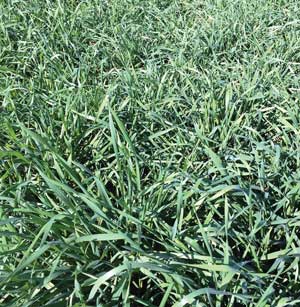 Rye is nutritious, with up to 25% protein. |
|
|
|
|
Rye can be planted anytime from early August to late November, depending on the climate and conditions. To plant rye, start with a soil sample and use lime to ensure a pH of 6.0-7.0. It can be planted in a variety of soils, but rye is at its best in well-drained clay, sandy, or loamy soils.
Select a site that receives a minimum of 8 hours of full sun. Prepare a clean, smooth, and firm seedbed by plowing and dragging the soil. Rye can be broadcast in small food plots using a hand seeder or an ATV-mounted seeder. It can also be drilled if farm equipment is available. Plant seeds into the well-prepared, clean seedbed at a seeding rate of 100 pounds per acre (2¼ lbs. per 1000 sq. ft.) when planted alone, or 30-50 pounds per acre when used in mixes. Planting depth should be ¾ to 1½ inches deep when planted alone or in mixes with other small grains; ½-inch deep when planted in mixes with annual clover and/or brassica. Cover the seed by lightly disking or dragging the soil.
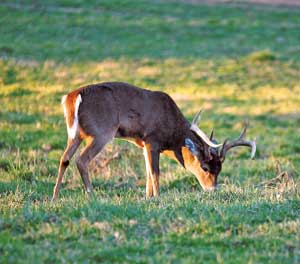 Where the weather is harsh and the soil less than perfect, rye can excel, making it a good choice for a food plot crop under those conditions. Where the weather is harsh and the soil less than perfect, rye can excel, making it a good choice for a food plot crop under those conditions. |
|
|
|
|
To fertilize, use 300-400 pounds of 13-13-13 per acre, but soil tests may indicate the need for a fertilizer with higher nitrogen content. Some seed companies recommend the use of high-nitrogen fertilizer in February or March.
At this writing, the approximate cost of certified rye seed is $.50 to $1 per pound, depending on the variety and availability, making it an inexpensive food plot crop. Since there are many varieties of rye available, and many are for use in specific regions of the United States, it is best to check with your local Cooperative Extension Service agent to see what variety is best planted for your area of interest. Also, where rye seed is sold by bulk, avoid buying cheap floor sweepings which are not inspected. They may contain noxious weed seed that will grow in your food plots, creating a problem down the road.
While rye can be used as a stand-alone winter food plot crop, it usually serves a deer management program best when used as part of a food plot crop mix. Here are some do-it-yourself mixes you can produce using rye as a base seed:
|
Northern U.S. Cool Season Mix
|
Southern U.S. Cool Season Mix | |||
|---|---|---|---|---|
| Mix 1 100 pounds grain rye 5 pounds ladino clover |
Mix 2 50 pounds grain rye 5 pounds birdsfoot trifoil 5 pounds red clover 5 pounds white clover 20 pounds Austrian winter pea |
|
Mix 1 60 pounds grain rye 10 pounds crimson clover 10 pounds arrowleaf clover |
Mix 2 30 pounds grain rye 30 pounds wheat 5 pounds durana clover 7 pounds red clover 2 pounds chicory |
When planted in the right area under the right conditions, rye will attract and feed deer and rabbits, and provide nesting cover and bugs for turkey and upland birds. It is an inexpensive seed that is easy to plant and is forgiving in many harsh weather and soil conditions.
|
J. Wayne Fears, the Food Plot Doctor, is one of the pioneers who helped develop food plot practices that are common today. Now, his decades of experience are available to Whitetails Unlimited members. J. Wayne uses questions from our readers as the basis for his column as the Food Plot Doctor. Just email your questions to foodplotdr@aim.com. The Food Plot Doctor columns will be archived on the WTU website, so you can go back to them for reference in the future. Unfortunately, J. Wayne will not be able to respond to emails individually, but will find common themes from your questions to write about. So get busy, find that thing that's been driving you crazy, or that one topic on which everyone else seems to have directly opposite opinions, and let J. Wayne give you the straight scoop. |
« Top »
Site made with by Upward Engine