Whereas,
Whitetails Unlimited, Inc. is a national 501(c)(3), non profit organization with a well-defined mission of to raise funds in support of educational programs, wildlife habitat enhancement and acquisition, and preservation of the shooting sports and hunting tradition for future generations. Whitetails Unlimited insists that the time, energy and resources of this organization are best utilized in support of our mission; and
Whereas,
Whitetails Unlimited is regularly approached and solicited by a wide variety of agencies, groups and individuals in an effort to enlist the support of Whitetails Unlimited in a particular effort, cause, policy, regulation or law.
RESOLVED,
The policy of Whitetails Unlimited is that, with rare exception, Whitetails Unlimited will not become involved in controversial issues that are normally decided in political, regulatory or community venues. In addition, Whitetails Unlimited will not become involved in the partisan political process, including endorsing candidates for any particular office.
However, Whitetails Unlimited encourages individual members, outside of their membership in Whitetails Unlimited, to become active in the political process with issues that relate to natural resources on local, state and national levels, and to vigorously exercise those rights and responsibilities accorded to all U.S. citizens. There are numerous credible national organizations designed to advance issues common to conservation organizations, and Whitetails Unlimited will work within these groups when it is determined that it is in the best interest of Whitetails Unlimited to do so.
If Whitetails Unlimited does become involved in a specific issue, it is because of unusual circumstances, or when the issue has a central and/or immediate effect on organizational operations or our core mission(s). Note: This involvement will occur only with specific action by the Board of Directors.
Whitetails Unlimited will continue to present information through its publications and website about issues that may be controversial, but this information is offered in an attempt to educate and inform our membership on issues facing wildlife or wildlife management, rather than advocating for a particular position.
The reasons for declining to become involved in specific issues are many. They include:
Whitetails Unlimited supports the philosophy that these issues should be decided via the local or state regulatory and legislative process. Whitetails Unlimited does not have the resources available to properly evaluate the countless proposals and issues that arise throughout the U.S., each of which includes; unique cultural, historical, legislative, regulatory and scientific components. In addition, management goals, methods and techniques, and social, political and cultural conditions may change, sometimes very quickly, and Whitetails Unlimited is not in a position to monitor and evaluate these changes in multiple jurisdictions nationwide.
As a national organization with a very diverse membership, it is important for Whitetails Unlimited to stay true to its core mission, and to let the regulatory and legislative process determine policy in each state or area. The stand of Whitetails Unlimited on political issues can best be described as “neutral,” where the knowledge and process at the local level is the best method to provide stewardship of our common natural resources.
Individual members of Whitetails Unlimited staff are sometimes approached to provide input or be members of Committees, Boards, Panels, or other similar organizations that relate to issues regarding deer, deer hunting, conservation, or other topics regarding outdoor recreation. In addition, employees may also be active in professional, community, or fraternal organizations and activities outside of their employment.
The policy is to prohibit the use of official titles to avoid the appearance of inappropriate endorsement by Whitetails Unlimited, or for private gain.
There are three areas discussed here:
Non-related Activities: These activities could be things like running for local elective office or working as a volunteer, where a biography would note that “Joe Smith is employed by Whitetails Unlimited as a state field director.” This is just a factual statement, and it is obvious that the activity is not directly related to the individual’s employment.
Generally, when engaged in outside activities, employees should not use or reference their titles or Whitetails Unlimited, except as one of several biographical details and provided it is given no more prominence than other significant details.
Activities That May Be Related: WTU representatives may have extensive and unique knowledge that may be of assistance to Committees, Boards, or Panels that may aid in their work, but WTU does not intend to involve itself in advocating for or against specific policies, as detailed in Resolution 101. Any individual considering serving on specific Committees, Boards, or Panels needs to evaluate how effective they can be serving under the restrictions mandated by Resolution 101 before applying or accepting appointment to such organizations.
An employee can use their official Whitetail Unlimited title in connection with outside activities, provided the employee's title or position is not used in a manner that could reasonably be construed to imply that Whitetails Unlimited sanctions or endorses the employee's activities. Therefore, employees may use their official title in connection with an outside activity only as follows:
An employee may permit his/her name and official title in connection with an outside activity as long as there is a prominent disclaimer indicating that the employee is serving in a personal capacity, e.g., the name and official title may be listed on the letterhead or other program provided that the listing contains an asterisk with an explanatory side or footnote stating that the individual serves in his/her personal capacity. A disclaimer will let readers know the person is speaking solely for his or herself, not for the organization or as a formal representative of Whitetails Unlimited.
Example: As a member of Hunting Advisory Committee for a state Department of Natural Resources (DNR) in his personal capacity, Mr. Smith serves to enhance dialogue between the DNR and deer management stakeholders on the state’s deer management program. His name and title are listed on the committee as follows: John Smith, Whitetails Unlimited, Inc. and at the bottom of the list is the following disclaimer: *Mr. Smith is serving in his personal capacity.
If you identify yourself as an associate or employee of Whitetails Unlimited and publish any work-related information in print, video, audio, or online, you must use the disclaimer: “The postings on this site are my own and do not necessarily represent the postings, strategies, or opinions of Whitetails Unlimited.”
OR: This [explain activity] was prepared or accomplished by [insert author's name] in their personal capacity. The opinions expressed in this article are the author's own and do not reflect the view of Whitetails Unlimited.
Example: An employee may use, or permit the use of, his/her title in connection with authorship of an article to be published in a conservation publication, provided that the title or position is accompanied by a reasonably prominent disclaimer stating that the views expressed in the article are the employee's and do not represent those of Whitetails Unlimited.
Example: Field Director, John Smith works with a university professor as part of his teaching at the local university. They jointly prepare an article for publication in a scientific journal. He may use his WTU title, but it must be accompanied by the following disclaimer: John Smith contributed to this article in his personal capacity. The views expressed are his own and do not necessarily represent the views of Whitetails Unlimited Inc.
Official Duties: No disclaimer is needed. When an employee is engaged in any official duty or activity, the employee may use his/her official Whitetails Unlimited title without violating the policy. In an official duty, the employee represents Whitetails Unlimited and therefore reference to current official position or title is permitted. This applies to speaking, writing, and any other activities carried out on behalf of Whitetails Unlimited. It is incumbent on the employee to carefully evaluate meeting agendas, their conduct during meetings, all documents on which their name and/or WTU affiliation may appear, comport with Resolution 101, and to keep WTU management informed of ongoing activities.
Whitetails Unlimited Inc. is a national 501(c)(3), nonprofit organization with a well-defined mission of raising funds for the direct benefit of the white-tailed deer and other wildlife, education, habitat enhancement, and preservation of the hunting tradition. Whitetails Unlimited is not an advocacy organization.
With very rare exceptions, Whitetails Unlimited does not participate in controversial issues that are normally decided in a local, state, or federal legislative process.
Since our founding in 1982, Whitetails Unlimited has supported the safe, legal, and ethical use of firearms and other implements used in regulated hunting and the shooting sports, and does fully support the Second Amendment. Firearm safety is always an overriding factor in all of our shooting sports programs.
We abhor and condemn the illegal use of firearms, and support law enforcement at all levels to curb gun violence. We have always supported firearm and ammunition security measures to protect children, and prevent unauthorized persons from accessing firearms and ammunition.
The reasons for declining to become involved in specific issues are many. They include:
As a national organization with a very diverse membership, it is important for Whitetails Unlimited to stay true to its core mission, and to let the regulatory and legislative process determine policy in each state or area.
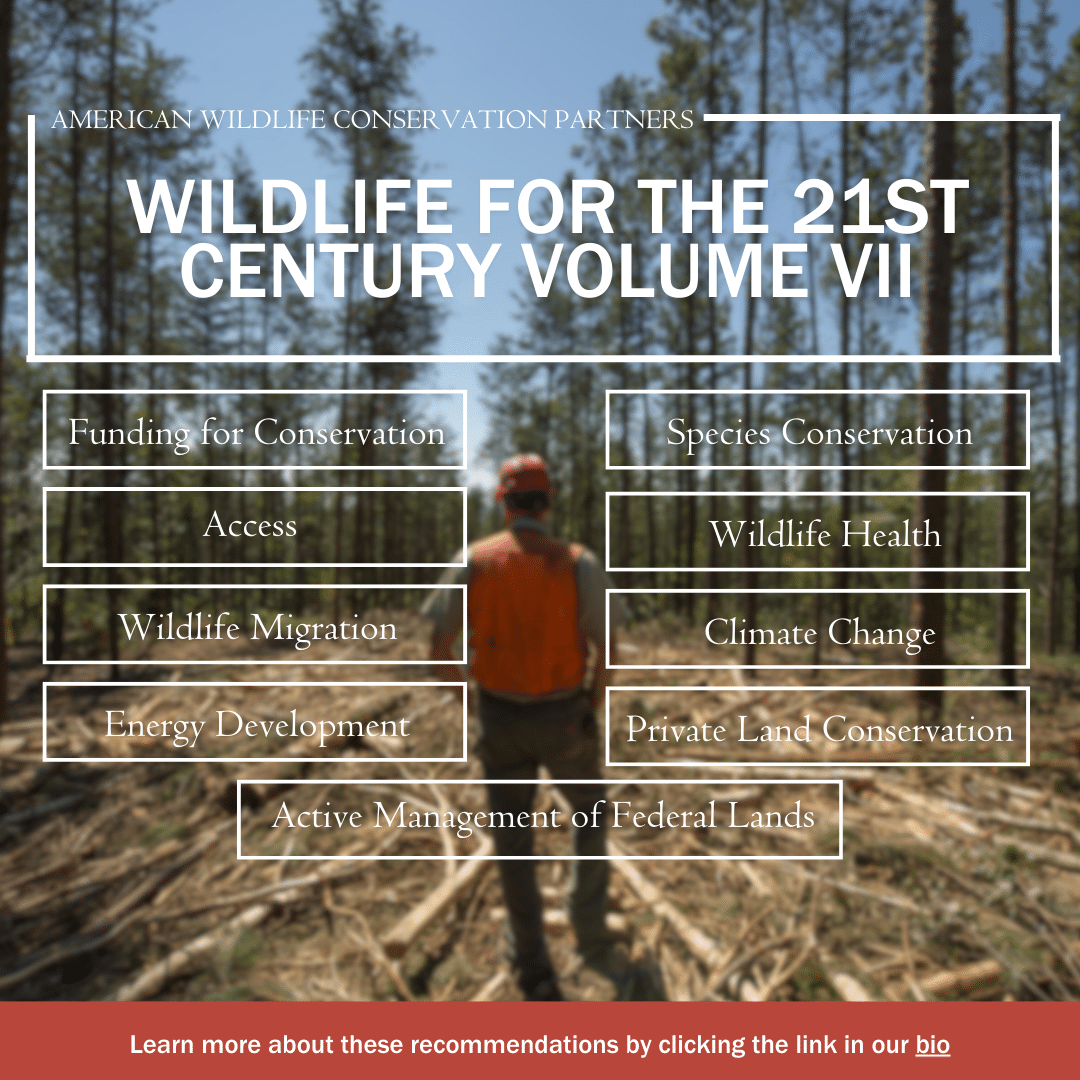
What is the AWCP, their Wildlife for the 21st Century Volume VII, and how is Whitetails Unlimited involved?
AWCP
The American Wildlife Conservation Partners (AWCP) was founded in 2000 to bring together conservation and wildlife management organizations. Its hope was, and still is today, to bring together similar organizations to help support conservation and the challenges that come along with it. Why is the AWCP so important? The idea behind it is “to leverage individual strengths for the greater good of conservation and access.” In other words, the AWCP and the 52 conservation organizations that belong to it come together to collectively address current issues surrounding “sportsmen and sportswomen, wildlife, and our treasured lands and waters.”
The AWCP is a leading voice when it comes to managing the animals we hunt and the land and natural resources we often take for granted. They are constantly working to develop new ideas and strategies, primarily on a federal level. While they are overseeing the bigger picture, they are also regularly receiving input and advice from smaller or more focused organizations. It is through this collaboration that conservation organizations are able to advocate their needs and concerns, while helping support the bigger picture when it comes to conservation.
Here are a couple of facts courtesy of the AWCP to help bring their relevance into perspective: Just last year, American sportsmen and women contributed $3.3 billion in conservation efforts. These funds are largely generated by hunting and fishing licenses and hunting, recreational shooting, fishing, and boating-related excise taxes. Also, 60% of funding for state fish and wildlife agencies is paid for by sportsmen and women, showing us just how important it is that we, as hunters and shooters (and any other outdoor recreationists), make a difference in conservation.
Wildlife for the 21st Century Volume VII
This brings us to the recently released Wildlife for the 21st Century Volume VII, the AWCP’s most recent volume providing guidelines and recommendations to the next presidential administration and the next two Congresses. The nine recommendations included in this volume “will bolster fish and wildlife populations, enhance the conservation of America’s lands and waters, and provide crucial access opportunities for America’s tens of millions of sportsmen and sportswomen.” The following is a brief overview of each of the nine recommendations:
1. Protect and Secure Permanent and Dedicated Conservation Funding – Funding is a crucial instrument to the AWCP; without the funds needed to help support conservation, there are limited resources available. A few recommendations on the AWCP’s list include maintaining the Pittman-Robertson Act, an act that created an excise tax on firearms, ammunition, and other items hunters and shooters typically purchase, and to increase funding surrounding the prevention and control of invasive species.
2. Enhance Access for Hunters, Recreational Shooters, and Other Recreationists – According to the AWCP, “Access is cited as one of the greatest factors limiting hunting participation.” Therefore, increasing access, particularly public land access, will help provide an avenue for more and more individuals to explore the hunting, shooting, and outdoor worlds. Under this recommendation, current land access and opportunity also need to be protected. Another relevant recommendation to today’s day and age is to improve public land access databases, especially when it comes to smartphone users.
3. Institutionalize and Support Wildlife Migration Corridors and Habitats – Most wildlife travel to and live in multiple different habitats throughout the year. Since there is so much movement, it is vitally important to protect the pathways for the wildlife using them. One main recommendation here revolves around transportation planning and infrastructure to significantly reduce wildlife-vehicle collisions.
4. Ensure Wildlife and Habitat Goals are Integrated into Energy Sources and Impacts are Mitigated – This recommendation states, “All forms of energy development impact land …” which, in turn, directly impacts wildlife. To offer one solution to this issue, the AWCP recommends including wildlife and habitat discussion in energy project planning, specifically in the early stages of planning.
5. Incentivize Private Landowners to Conserve Wildlife and Habitat – Private land consists of more than two-thirds of U.S. land area; due to this extremely large area, it’s recommended that programs be put in place to incentivize landowners to put forth effort when it comes to addressing wildlife habitat needs on their property. One example of this is the Farm Bill, “the largest single source of funding for conservation on private lands,” that the AWCP would like to see enhanced.
6. Improve Public Land Wildlife Habitat Conservation by Increasing Active Management, Collaboration, and Reducing Litigation – Managing the habitat on public lands, such as those under the U.S. Forest Service and the Bureau of Land Management, is crucial when it comes to protecting these lands and the wildlife that inhabit them. Wildfires cause great damage to public forests, so ensuring continued funding to reduce the risk of wildfires is just one recommendation of the AWCP.
7. Achieve Greater Results from an Improved ESA and Overall Species Conservation by Enhancing the Use of Collaboration and Incentives – When states, organizations, and individuals work together, conservation efforts are often much more successful. The AWCP recommends creating incentives for collaboration, especially early intervention—particularly when it comes to endangered species. In addition, it is also recommended that the Endangered Species Act (ESA) be improved upon by creating “targeted regulatory and statutory improvements.”
8. Support and Assist State Fish and Wildlife Agencies in Addressing Wildlife Health Challenges – The two most prevalent diseases affecting wildlife today are Chronic Wasting Disease (CWD) in deer and pneumonia in sheep. To help combat these challenges, the AWCP suggests collaboration between agencies and organizations, especially when it comes to risk reduction. However, this—or any—approach would be difficult without dedicated funding, which is needed to sustainably build and maintain these programs.
9. Enhance the Resilience of Wildlife Habitat and Wildlife Populations in the Face of a Changing Climate by Strengthening Conservation and Restoration Programs, Policies, and Funding – Extreme weather of late has greatly impacted wildlife and their habitat as our climate continues to fluctuate and change. To help offset these challenges, it’s recommended that improvements to existing conservation programs be made to encourage natural infra-structure solutions. This is because “functioning natural ecosystems adjacent to and incorporated in these developments will aid in mitigating climate change effects …”
Whitetails Unlimited’s Involvement
Whitetails Unlimited, as the nation’s premier nonprofit white-tailed deer organization, is a proud partner of the AWCP. It is our duty as a conservation organization to represent America’s conservationists, especially when it comes to hunting and shooting. It is vitally important to have a voice surrounding the future of wildlife and conservation in America, as well as an overarching organization that takes our voice and opinions into careful consideration.
One of the AWCP’s recommendations revolves around land access for hunters and shooters (Recommendation Two). This also happens to be one of Whitetails Unlimited’s four pillars, the HOPE (Habitat Options & Planned Enhancement) for Wild-life Program. This program focuses on wildlife habitat, hunter access, and the reduction of poaching. One specific example of a recent WTU HOPE project is a $10,000 grant to the Linn County Conservation Board in Toddville, Iowa. The funds were used for the acquisition of a 57-acre tract of land that will be desig-nated for archery hunting of deer. This is just one of many land acquisition grants that has been presented to various organiza-tions around the country to provide more public land access for hunters and habitat for wildlife. Although Whitetails Unlimited is doing our part to help combat land access and wildlife habitat challenges, it’s important that the issue is projected into the spot-light as one of the AWCP’s nine recommendations.
As Whitetails Unlimited continues to advocate for educational programs, wildlife habitat enhancement and acquisition, and the preservation of shooting sports and the hunting tradition, we will also continue to be a leading voice in the conservation of wildlife and land around the nation. With the overarching leader-ship of the AWCP, along with conservation organizations such as ours, we will continue to protect America’s wildlife, land, and waterways for years to come.
To access the entire Wildlife for the 21st Century Volume VII, click here.
Site made with by Upward Engine