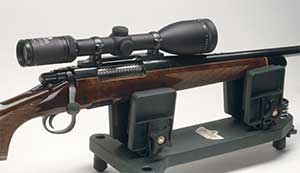
Tip 1: Right Rings and Base(s).
Buy quality rings and base(s); this is no place to save a couple of bucks. Bases may be one- or two-piece, depending on the rifle. Most rifles now come drilled and tapped for the base. If yours isn’t, take the job to a gunsmith. Rings come in three heights; the medium height will work for the vast majority of gun/scope combinations. Don’t ever mount a scope that touches the firearm anywhere except the rings.
Tip 2: Right Tool for the Job.
Find a well-lit area to work, where you can hold the rifle securely. Use high-quality screwdrivers that actually fit the screwheads — you don’t want to end up with a big scratch on your firearm!
Tip 3: Clean and Oil.
Remove the filler screws in the rifle, and clean any oil or grease from the screw holes, base screws, and the surface of the base. Apply a thin layer of oil on the rifle and bottom of the base where the two will be in contact. The base will not likely ever be removed, and you don’t want rust to develop here. Don’t get oil into the screw holes. The new base screws (that come with the base) are often different lengths, so determine which screw goes into which hole.
Tip 4: Righty Tighty, Lefty Loosey.
Scope bases can become loose after repeated recoil, so put a small amount of Loctite® on one side of the threads, and tighten the base screws as much as possible. If the rifle shifts as you torque the screws here, the screwdriver can damage the rifle. Be sure you only use Loctite on the base screws, never on the rings.
Tip 5: Rotate That Ring.
The front ring normally has a dovetail, where you insert the ring into the base and rotate it into place. A light coating of good grease on the ring foot can help. It is difficult to rotate the ring by hand, but NEVER use the scope itself to turn the ring! Get a 1-inch section of wooden dowel and use that to rotate the ring. Leupold makes a ring wrench for this that works well.
Tip 6: Get Everything Square.
Insert the rear ring into the base, and tighten. It is important to have the rings both perpendicular to the rifle, so the scope will rest squarely, without being twisted by the rings. When you think the rings are square, put the scope in the rings and examine it closely to see if it is truly square. If you can’t find any problems visually, slowly rotate the scope and see if it binds anywhere. If so, take the scope out and move the ring(s) as needed with the dowel.
Tip 7: Final Adjustments.
Assemble the scope and rings, and tighten the rings just until there is some friction with the scope. Now look through the scope and rotate it until the crosshairs are straight, and move the scope forward or back until you have the optimum sight picture. You should be able to see the entire field, but don’t get the scope too close to your eye. Around four inches is right for most people. Then tighten the ring screws securely.
Tip 8: Go Have Fun.
You need to boresight the rifle, and then head to the range. Start at a close range, and then sight-in at your normal range.
Site made with by Upward Engine