Tip 1: It’s all About the dB.
The decibel is the base unit to describe sound pressure levels and was invented by Bell Labs about 100 years ago when telephone use was quickly expanding. The name honors Alexander Graham Bell (for some reason it was shortened to ‘bel’) and the ‘deci’ prefix indicates that the base unit is 1/10 of a bel (a whole bel is seldom used). This scale is logarithmic, meaning that as the number goes up 10 points, the amount of pressure goes up 100 points (the technical explanation is complicated). This scale is useful because the range between the quietest sound a human ear can perceive and when short exposure causes permanent damage can be more than 1 trillion.
Tip 2: Sound Surrounds Us.
There is always sound around us, and a chart of noise levels shows that normal conversation comes in at 60 dB, while a hair dryer or power lawn mower can be 90 dB. An ambulance siren can be 120 dB, a jet engine at takeoff can be 140 dB, and a 12-gauge shotgun scores 165 dB. Also on the chart is a rocket launch at 180 dB, and the ‘loudest possible tone’ is charted at 194 dB (don’t know what that would be).
Tip 3: The Danger is Real.
Inside your ear are tiny hairs which connect to nerves that transmit sound signals to the brain, and loud noises can damage these. Intensity and duration are key variables, but even a single gunshot can cause damage. Once the ear is damaged, it does not return to normal, and future injuries continue to build on the damage. As we age, there is some normal loss of hearing, and additional damage will make normal loss even worse.
Tip 4: Do the Right Thing.
It is rare to see someone at a shooting range who does not use hearing protection, but it is also rare to see a hunter actively protecting their hearing in the field. That needs to change. Many deer hunters rationalize that, ‘It’s only one or two shots.’ That may be true, but one or two shots, season after season, can result in a lot of damage. Add to that other seasons (small game, birds, varmints) and that’s a lot of preventable damage to your ears. A .22 rifle may be the quietest firearm, but even that can produce 140 dB with every pull of the trigger. A .308 is as loud as a 12-gauge (167 dB). If you pull the trigger and your ears hurt or ring, you’ve caused damage.
Tip 5: Active vs. Passive.
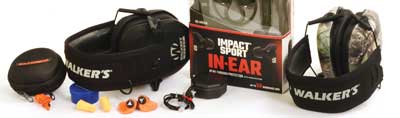
Passive hearing protection includes earplugs and earmuffs. These are effective, but reduce all sounds reaching your ears, including subtle sounds like a deer approaching your stand. Active hearing protection can also be plugs or muffs. Electronics in the device let you hear what is going on around you, but detect loud noises and prevent them from reaching your ears. Most have a volume control knob. At high volume, every tiny noise in the field is readily apparent.
Tip 6: What to Do?
The easiest and least expensive option is foam earplugs. At the top end are custom-fitted, active earplugs that amplify the noise around you until the shot is fired, and then automatically shut off the loud sound impulse. These will set you back several hundred dollars but are the most comfortable to wear for long periods of time. The ultimate is a suppressor on your firearm, but it’s more expensive and involves paperwork and a long wait.
Tip 7: Choose and Use.
Regardless of how often you hunt or what kind of firearm you use, you need to protect your hearing while hunting. Be as diligent with protecting your hearing in the field as you do at the range.
Site made with by Upward Engine